Biological Products:
Bioaugmentation products for Wastewater applications in Papermills, Refineries, Chemical, Tanneries, Municipalities, Textiles, Steel, Agriculture, Animal feedlot, Gun Powder plant, Food and Beverage- Dairy Products, Orange Juice factory, Wineries, Cookie factory, Vegetable processing plant, Meat packing, Barbecue Restaurant, Aquaculture, Ornamental Ponds for algae control, CAFO, Nursing homes, Military, Campgrounds, Universities, Regulatory agencies
Lab Services:
Filamentous Identification Lab Service. One reason to identify filaments is to determine the filaments characteristics and then determine the type present. If the type is found out, a root cause can usually be associated with a particular filament. If the cause is known, then a correction can be made to alleviate problems. Chlorination is only a quick fix. Without process changes, filaments will grow back after chlorination. Wastewater Biomass Analyses and Cooling Tower Analyses also available
Training Materials:
Training is an integral part of any job. Not everyone is at the same level of training. Many people want beginning concepts and basics. Some need technical information or troubleshooting. Some want equipment, technology or process information. We have developed a full set of Basic training, Advanced training, Filamentous Identification the Easy Way as well as custom training CD's Manuals. We also provide hands-on training classes and soon will have an Online "E-University".
|
Type 021N Latest News!
We hope you like the new look of our Filamentous Bacteria Identification Pages If you would like more information on filaments, you might want to consider purchasing our Filamentous Identification the Easy Way Training materials. We also have our lab that can perform a Filamentous identification lab analyses of your own MLSS for more information
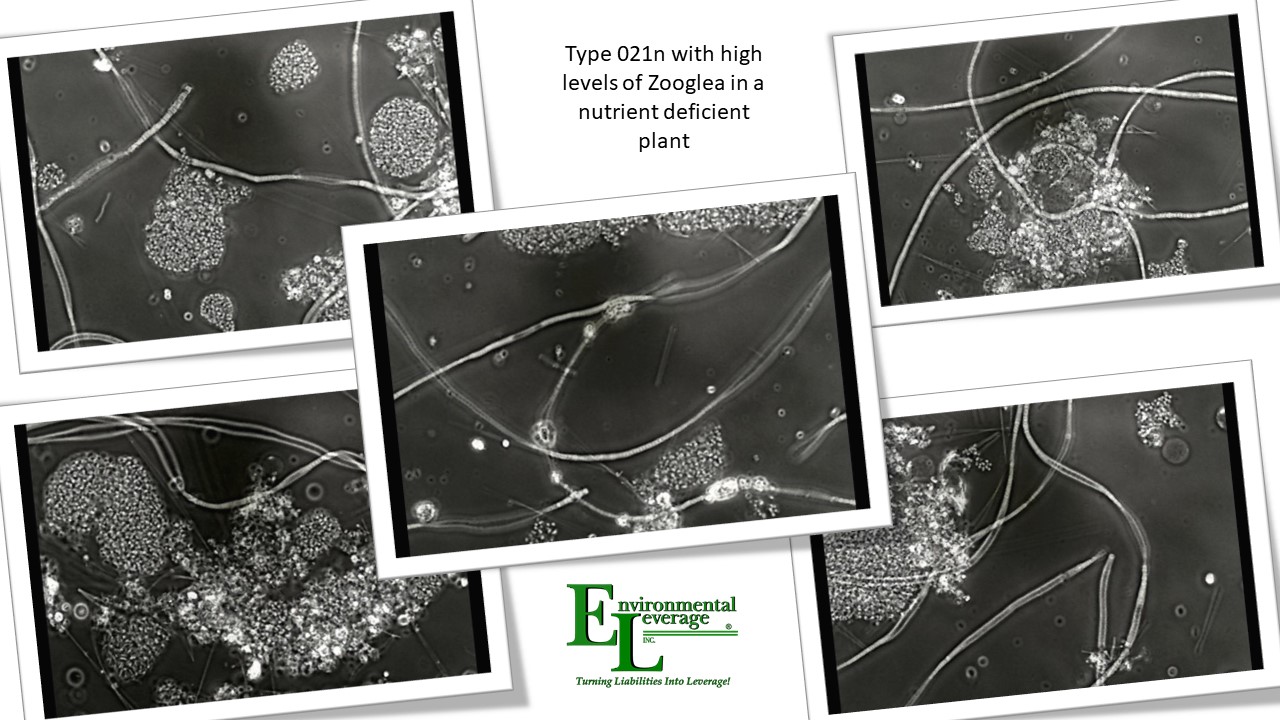
Type 021N This filament always looks different. It may be wider in some municipalities, longer in industries depending upon whether it is caused by nutrient deficiency or septicity. It may be there are more than one versions of this filaments. Technically consider this a group of filaments with similar looks. Don't get overly technical. When trying to determine species, stick to the basics, and focus on the causes and controls of the filaments present. The main point of any filamentous identification is not to get a PhD, but to fix your plant!
Identification Identification: Relatively large , non-motile filaments (100->1000 µm). Straight or smoothly curved, sometimes coiled filaments with no branching. Characteristic looping seen. Filaments taper from a thick basal region, and often exhibit a holdfast to a thinner apical region, terminating in a loosely attached gonidia ( a distinctive rod-shaped cell at the trichome end). Rosettes are observed infrequently. Rosettes are when many filaments radiate outward from a common origin. The cell septa are very clear with indentations. Cells are very irregular, large and usually square but can vary from disc, ovoid, rod or barrel shaped, sometimes even in the same filament (1.0-2.0 µm). Filaments are found within the floc structure and the bulk solution when in rapid growth stage. The filament staining is usually Gram negative and Neisser negative with Neisser positive granules. Can be Gram positive when sulfur granules are present. Usually easy to identify due to its irregular shaped cells. There is no sheath, although a heavy cell wall will remain after cell lysis with chlorination. There may be intracellular sulfur granules and often responds to S-tests. Poly-ß-hydroxybutric acid (PHB) granules are frequently observed as dark intracellular granules. No attached growth.
Similar Organisms: At least five other organisms can be mistaken for this filament because of its variable cell shape, N. limicola, Thiothrix or Type 0041 especially.
Environment This filament is usually found in environments where there is septic wastes, or wastes with sulfides or organic wastes , N deficient wastes and low F/M when the waste is composed of simple sugars or organic acids. Grows readily in food processing, wet corn milling, brewing and malting, fish processing petrochemicals and pulp and paper mills.
Control: If the S test is positive, the cause is septic wastes or presence of sulfides and can be remedied by pre-aeration or pre-chlorination. Check solids handling. Also check for septic supernatant from dewatering processes. Nitrogen deficient wastes can be checked by effluent values of residual NH3 and should be supplemented. F/M can be changed by use of a selector. Chlorination should be definitely used if in the rapid growth phase.
Rank: Type 021N ranks 3rd in number of predominance. (SVI values can exceed 500 mg/l) Rapid growth of this filament can cause severe settling problems in only a few days.
For more information on Filamentous Identification More photos to come. . .
If you need more information on our Filamentous Identification the Easy Way Training CD or on Internet training on Filamentous bacteria, causes and controls. How and why on Wastewater Biomass Analyses Wastewater Bioaumgentation Products
|