Biological Products:
Bioaugmentation products for Wastewater applications in Papermills, Refineries, Chemical, Tanneries, Municipalities, Textiles, Steel, Agriculture, Animal feedlot, Gun Powder plant, Food and Beverage- Dairy Products, Orange Juice factory, Wineries, Cookie factory, Vegetable processing plant, Meat packing, Barbecue Restaurant, Aquaculture, Ornamental Ponds for algae control, CAFO, Nursing homes, Military, Campgrounds, Universities, Regulatory agencies
Lab Services:
Filamentous Identification Lab Service. One reason to identify filaments is to determine the filaments characteristics and then determine the type present. If the type is found out, a root cause can usually be associated with a particular filament. If the cause is known, then a correction can be made to alleviate problems. Chlorination is only a quick fix. Without process changes, filaments will grow back after chlorination. Wastewater Biomass Analyses and Cooling Tower Analyses also available
Training Materials:
Training is an integral part of any job. Not everyone is at the same level of training. Many people want beginning concepts and basics. Some need technical information or troubleshooting. Some want equipment, technology or process information. We have developed a full set of Basic training, Advanced training, Filamentous Identification the Easy Way as well as custom training CD's Manuals. We also provide hands-on training classes and soon will have an Online "E-University".
|
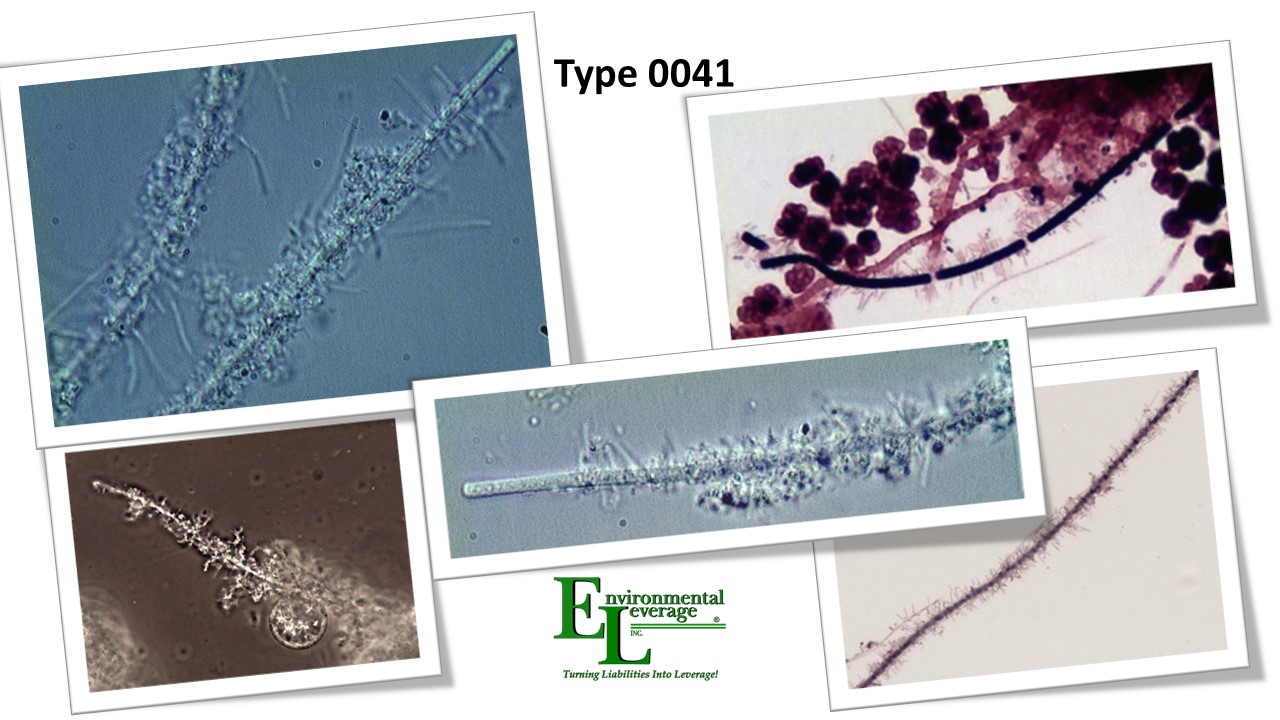
Type 0041
Latest News!
We hope you like the new look of our Filamentous Bacteria Identification Pages If you would like more information on filaments, you might want to consider purchasing our Filamentous Identification the Easy Way Training materials. We also have our lab that can perform a Filamentous identification lab analyses of your own MLSS for more information
Type 0041 This filament may look different. It may be wider in some municipalities, longer in industries depending upon whether it is clean or has attached growth. Don't get overly technical. When trying to determine species, stick to the basics, and focus on the causes and controls of the filaments present. The main point of any filamentous identification is not to get a PhD, but to fix your plant!
Identification Relatively large, non-motile filaments (100-500 µm). Straight, smoothly curved or bent filaments with no branching. Cells are square to rectangular (1.2-1.6 x 1.5-2.5 µm) and contained in a tight fitting sheath. There are no indentations at the cell septa. Filaments are found within the floc structure causing open, lacy floc or radiating outwards causing inter-floc bridging. The filament staining is Gram negative or Gram variable when in the floc structure with heavy attached growth and Neisser negative. Neisser positive slime coat frequently observed in industrial wastes. No sulfur granules. Can have heavy attached growth when observed inside the floc structure. No attached growth when extending into the bulk solution (usually when in a rapid growth phase, watch out for this, it usually means significant trouble). Sheath is difficult to detect except when missing cells.
Similar Organisms: Type 0675 is similar although smaller in diameter and is usually more Gram positive. Type 021N is similar when in the bulk solution and with no attached growth, although Type 021N has no sheath.
Environment This filament is usually found in environments where there low F/M with a long MCRT. It is typically a backbone filaments and very rarely causes bulking or bridging.
Control: F/M can be changed by increased sludge wasting or changing from complete mix to plug flow. RAS chlorination should be definitely used if in the rapid growth phase. After chlorination, sheath may still be present and interfere with SVI.
Rank: Type 0041 ranks 4th in number of predominance. Common in over 50% of sludge in low abundance. Can be beneficial at low abundance as a backbone structure for the floc. For more information on Filamentous Identification More photos to come. . .
If you need more information on our Filamentous Identification the Easy Way Training CD or on Internet training on Filamentous bacteria, causes and controls. How and why on Wastewater Biomass Analyses Wastewater Bioaumgentation Products
|