



Biological Products:
Bioaugmentation products for Wastewater applications in Papermills, Refineries, Chemical, Tanneries, Municipalities, Textiles, Steel, Agriculture, Animal feedlot, Gun Powder plant, Food and Beverage- Dairy Products, Orange Juice factory, Wineries, Cookie factory, Vegetable processing plant, Meat packing, Barbecue Restaurant, Aquaculture, Ornamental Ponds for algae control, CAFO, Nursing homes, Military, Campgrounds, Universities, Regulatory agencies
Lab Services:
Filamentous Identification Lab Service. One reason to identify filaments is to determine the filaments characteristics and then determine the type present. If the type is found out, a root cause can usually be associated with a particular filament. If the cause is known, then a correction can be made to alleviate problems. Chlorination is only a quick fix. Without process changes, filaments will grow back after chlorination. Wastewater Biomass Analyses and Cooling Tower Analyses also available
Training Materials:
Training is an integral part of any job. Not everyone is at the same level of training. Many people want beginning concepts and basics. Some need technical information or troubleshooting. Some want equipment, technology or process information. We have developed a full set of Basic training, Advanced training, Filamentous Identification the Easy Way as well as custom training CD's Manuals. We also provide hands-on training classes and soon will have an Online "E-University".
|
Stentor
What's New!
We now have a brand new "Higher Life Form videos" in our Training CD list. Check out our new Wastewater Training Materials. We are also in the process of developing new courses for our ""Online University" in order to meet the needs of our global customers that cannot travel to our public classes. WastewaterElearning.com/Elearning
We hope you like the new look of our Higher Life form Identification Pages If you would like more information on bacteria, filaments or higher life forms, you might want to consider purchasing our Wastewater Microbiology Training materials. We also have our lab that can perform a Wastewater Biomass lab analyses of your own MLSS for more information
Stentor
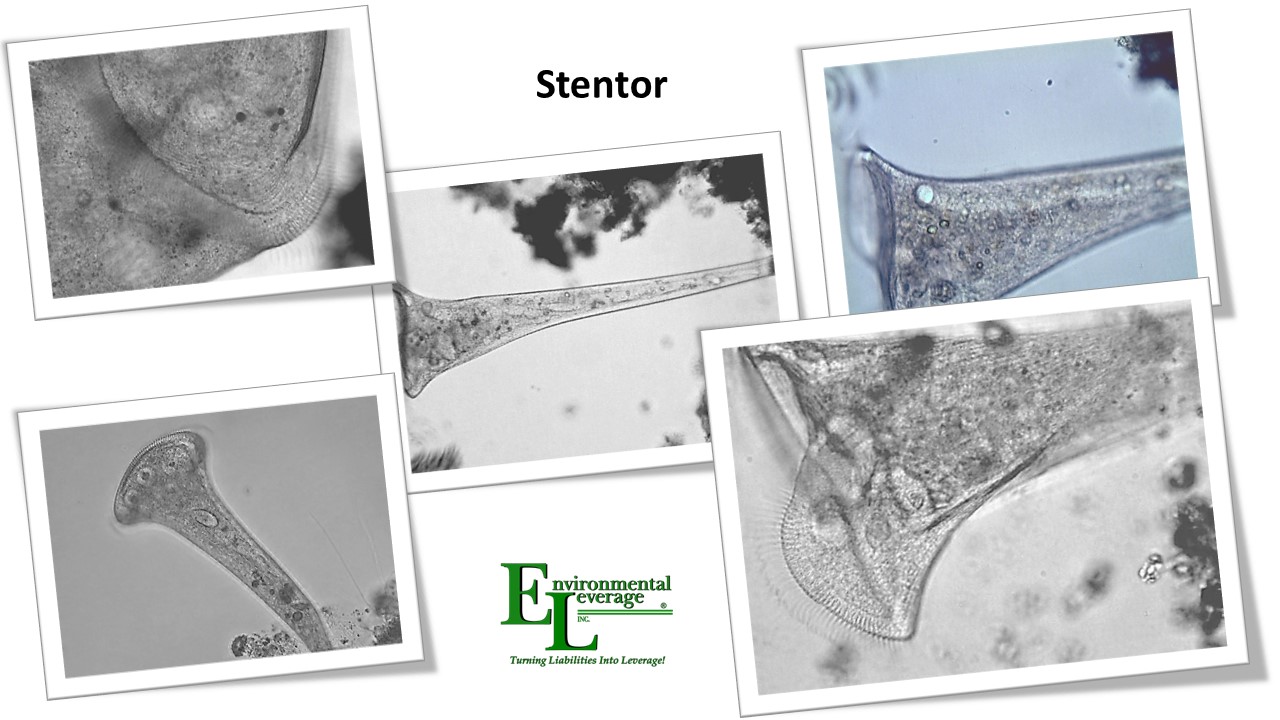
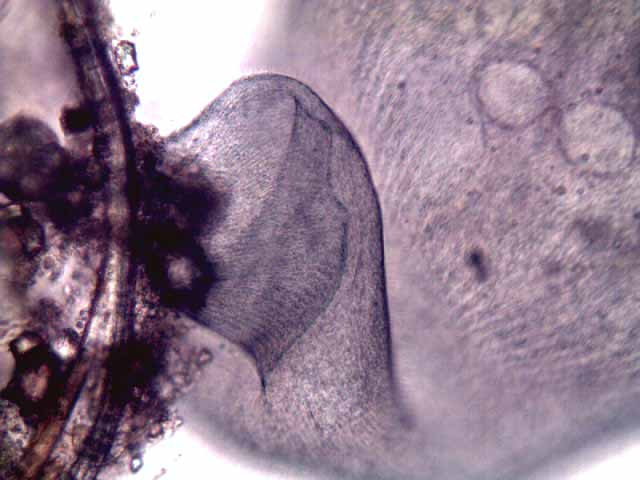
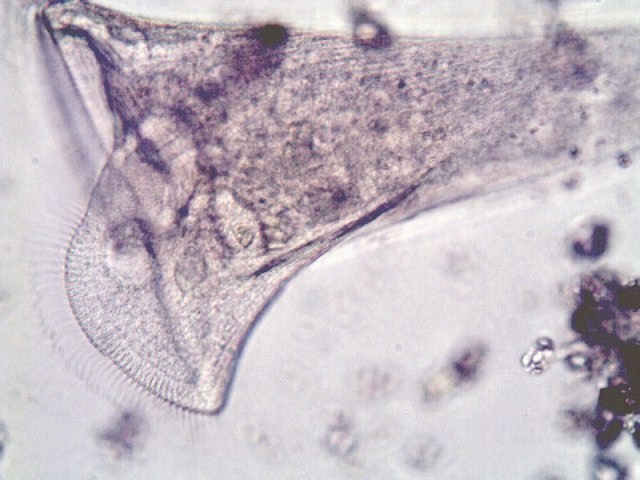
Identification Stentor are also known as the "trumpet animalcule," Stentor belongs to the class Spirotrichea in the phylum Ciliophora. They are some of the largest protozoans known and some species can be up to two millimeters (0.08 inch) long. Oftentimes, they are larger than many microscopic multicellular organisms such as rotifers and water fleas, and have been known to eat smaller members of these groups.
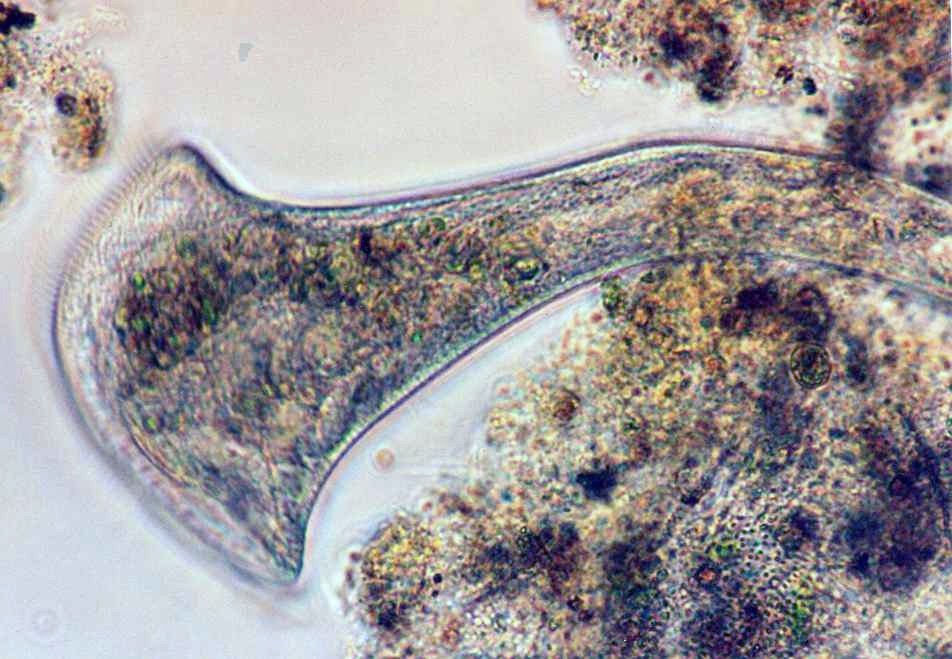
Stentor are similar to stalked ciliates. Stalked ciliates are "inverted bell-shaped bodies mounted on a stalk which is attached to a substratum." When attached to a substrate, the Stentor has a trumpet shape. Any disturbance makes the whole body contract to become a blob of protoplasm. The Stentor shrinks back and contracts similar to a rotifer also and then reaches out and stretches while feeding.
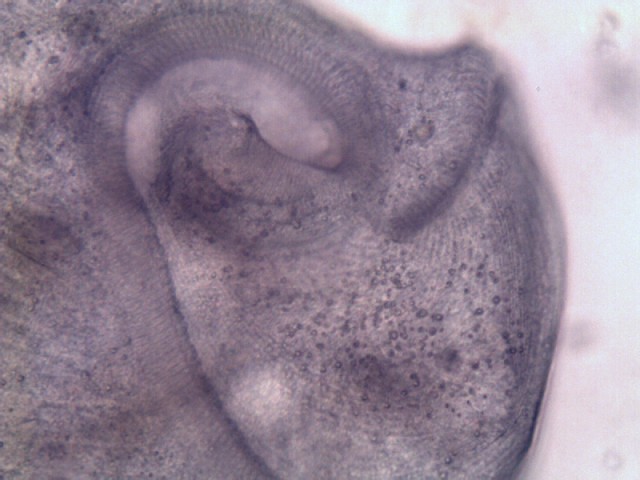
A key identification feature is the presence of cilia (minute hair-like projections) on the oral region and along the sides of the organism. The Stentor beat the cilia and create a vortex like movement with there cilia drawing in single celled bacteria to feed on. Stentor may also be swimming freely, when they become more oval or pear shaped with a narrowing at their posterior.
Additional Information: They are members of the class or phylum Ciliophora. Many different genera and species exist. The Stentor is remarkable for its regenerative powers; a fragment as small as one-hundredth the volume of an adult can grow back to a complete organism. This ability has made the Stentor a favorite subject amongst biologists for studies of regeneration in the protozoan kingdom.
In ornamental ponds or lagoons, Stentor can be very colorful - there can be green, blue and amethyst colored species. The green color is a result of ingested microscopic green algae. The algae live in symbiosis with the Stentor, i.e. the algae and Stentor mutually benefit from the close association. The algae uses photosynthesis to convert Stentor's waste products to useful nutrients.
Environment They are one of the higher life forms found in waste water treatment processes and in freshwater ponds. Stentor are usually an indication of a stable activated sludge operation. The species of stalked ciliates found can be used to indicate approximate MCRT. The colonial forms of stalked ciliates usually occur at higher MCRTs. Stentor are found in low numbers and when the bacterial population and dissolved oxygen concentration of the treatment process are high, the wastewater environment is stable and a mature floc structure has developed. Stentor ciliates usually indicate a stable wastewater environment and a healthy biomass.
How to find them: Microscopic examination of a wet mount. Some of the larger Stentors can be seen at 40-100x and 200x. Blow them up to 400x and 1000x though to see more details. The Stentor is so large that it takes numerous fields under 1000x microscopic to view the entire organism
Stentor consume food via vorticellids, oral cilia that wind completely around the top of the cell. Stentor attach themselves to the base of something, usually floc structures
More to come soon! For more information on Higher Life Form Identification Stalked ciliate Bug of the Month More photos to come. . .
If you need more information on our Filamentous Identification the Easy Way Training CD or on Internet training on Filamentous bacteria, causes and controls. How and why on Wastewater Biomass Analyses
|
 When
trying to determine species, stick to the basics, and focus on the causes
and controls of the higher life forms present. The main point of any
wastewater biomass identification is not
to get a PhD, but to fix your plant!
When
trying to determine species, stick to the basics, and focus on the causes
and controls of the higher life forms present. The main point of any
wastewater biomass identification is not
to get a PhD, but to fix your plant!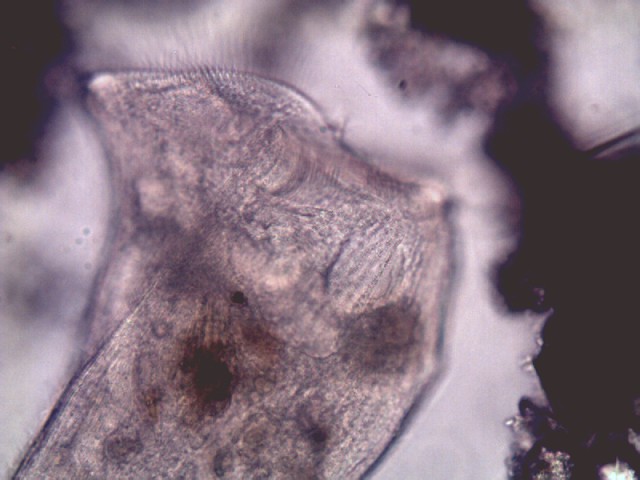
 More
on Stentor-
More
on Stentor- 
